 Taiji‑Europa
Baguazhang Basics: The Circular Internal Art
 By Julian Reeve, Tai Chi & Qigong instructor · Updated 23 May 2026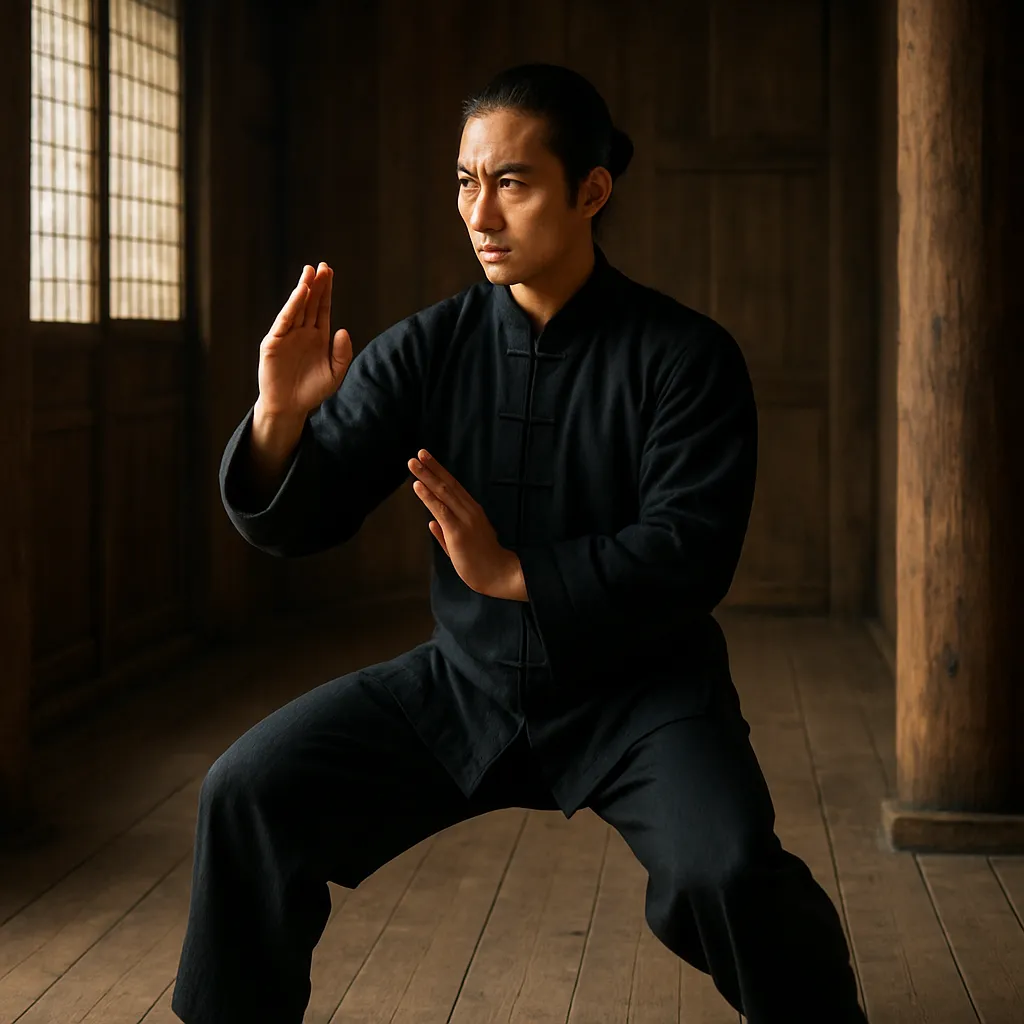
Baguazhang — "eight trigram palm" — is the most mysterious of the three classical Chinese internal arts. Where Tai Chi yields and Xingyiquan advances, Bagua circles. Its practitioners move in continuous spirals, rarely meeting force head-on. This guide introduces its foundations.
What is Baguazhang?
Baguazhang is an internal martial art built on constant circular movement and change. Its name refers to the eight trigrams of the I Ching, reflecting a philosophy of perpetual transformation. In application, the Bagua practitioner does not block and strike in straight lines; instead they walk around an opponent, evading and redirecting, attacking from angles. It is famous for its evasiveness and its flowing, almost dance-like footwork.
Circle walking
The single foundational practice of Bagua is circle walking: walking smoothly around the circumference of an imagined circle while holding the upper body in various postures and turning the gaze inward to the centre. Held patiently, circle walking builds the rooted-yet-mobile quality, the spiralling body connection and the calm, continuous breathing that define the art. As with Xingyi's Santi posture, much of Bagua is hidden inside this one deceptively simple drill.
The eight palm changes
From circle walking grow the eight palm changes — the technical core of the art. Each "palm" is a way of changing direction on the circle, turning the body in a spiral to face a new angle. Trained in sequence and then freely, the palm changes teach the practitioner to flow continuously from one position to another, never stopping, never committing fully to a single line. This relentless change is Bagua's signature, and its chief tactical advantage.
Bagua, Tai Chi and Xingyi
Together with Tai Chi and Xingyiquan, Baguazhang forms the classic trio of the internal arts, and the three are often studied together. They share the same internal principles — relaxation, rooting, whole-body power and a foundation in Qigong — but express them through opposite strategies: Tai Chi neutralises, Xingyi penetrates, Bagua evades. A practitioner who tastes all three gains a remarkably rounded understanding of what "internal" really means. For most beginners, though, a single art and a good teacher is the place to start; the others can wait.
Frequently asked questions
Is Baguazhang harder to learn than Tai Chi?
It is less commonly taught and its continuous circle walking can feel unusual at first, but it is no harder in principle. As with any internal art, patience and a good teacher matter more than raw difficulty.
What is circle walking in Baguazhang?
Circle walking is the foundational Bagua practice of walking smoothly around an imagined circle while holding postures and spiralling the body. It builds rooting, mobility and the art's characteristic continuous movement.
How does Baguazhang differ from Tai Chi?
Both are internal arts sharing the same principles, but their strategies differ: Tai Chi yields and neutralises in place, while Baguazhang moves constantly in circles, evading and attacking from changing angles.