 Taiji‑Europa
The Basics of Xingyiquan
 By Julian Reeve, Tai Chi & Qigong instructor · Updated 23 May 2026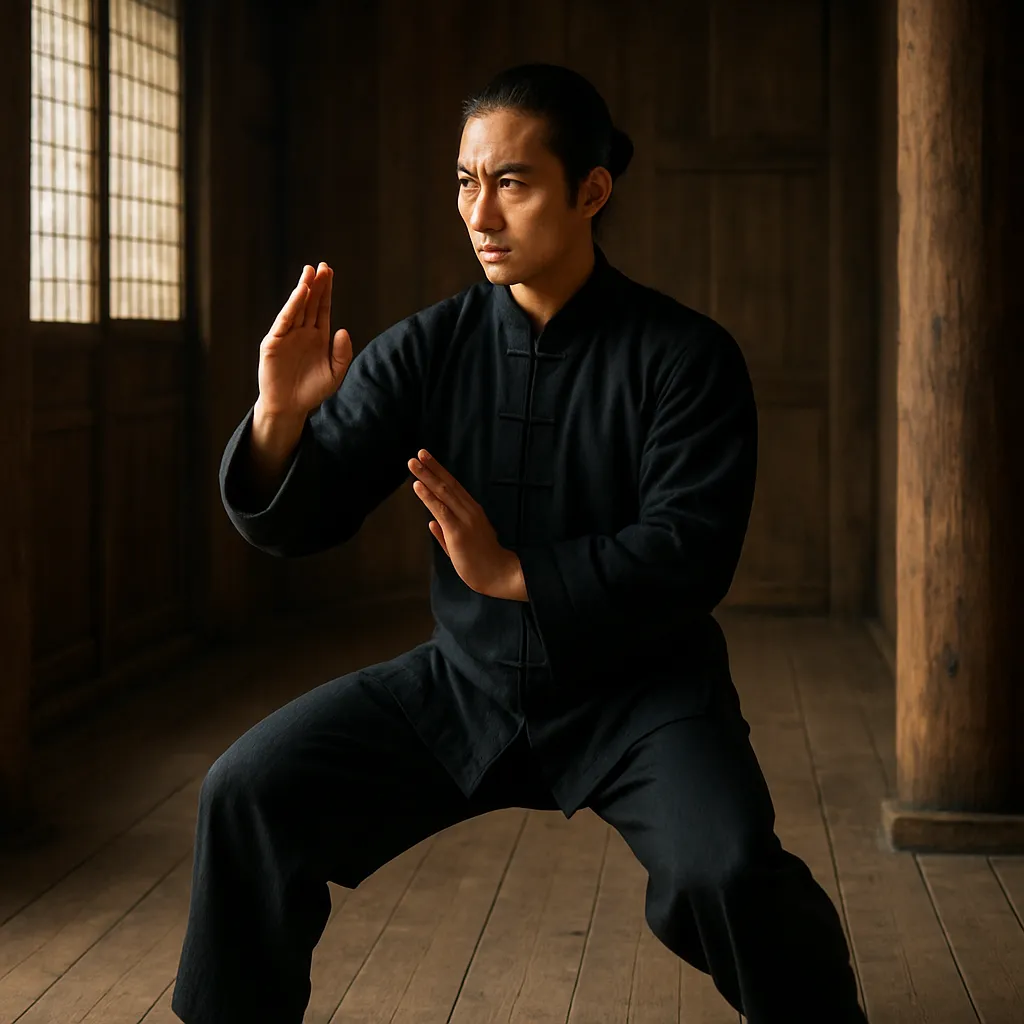
Xingyiquan — often translated "form-intention boxing" — is the most direct of the three classical Chinese internal arts. Where Tai Chi yields and Baguazhang circles, Xingyi advances in straight, decisive lines. This guide sets out its foundations clearly for the newcomer.
What is Xingyiquan?
Xingyiquan is an internal martial art built on simple, powerful straight-line movement. Its name points to its method: the yi (mind or intention) leads, and the xing (form) follows. Rather than long, flowing sequences, Xingyi cultivates a unified, whole-body power issued in short, committed movements — the body advancing as one connected unit behind each strike. It is often described as the most "external-looking" of the internal arts, because its power is so direct; yet its foundations are entirely internal: relaxation, alignment, breath and intention.
Santi Shi: the founding posture
Almost everything in Xingyi grows from a single standing posture, Santi Shi ("three-body posture"). Held patiently — minutes at a time, building to much longer — it trains alignment, rooting, and the deep connection between the upper and lower body that lets the whole frame move and issue power together. Many teachers say the entire art is hidden inside this one stance, and that months spent standing in Santi repay themselves many times over. As with circle walking in Bagua or standing practice in Qigong, the apparently simple drill is the real curriculum.
The Five Elements (Wu Xing)
The technical core of Xingyiquan is the Five Elements — five basic fists, each linked to an element of classical Chinese theory and to a direction of power:
| Fist | Element | Energy / line of power |
|---|---|---|
| Pi (Splitting) | Metal | A chopping, downward energy |
| Zuan (Drilling) | Water | A rising, drilling line |
| Beng (Crushing) | Wood | A direct forward strike — the signature of the art |
| Pao (Pounding) | Fire | An expanding, exploding movement |
| Heng (Crossing) | Earth | A horizontal, crossing power |
Trained singly, then in combination and in productive/destructive cycles, the five fists teach the student to issue whole-body power along every basic line. They are simple to learn and a lifetime to refine.
The Twelve Animals
Beyond the elements lie the Twelve Animal forms — dragon, tiger, monkey, horse, chicken, swallow and more — which apply the same internal power through varied shapes, angles and strategies. Where the Five Elements train pure lines of force, the animals add range, adaptability and character: the explosiveness of the tiger, the lightness of the swallow, the uprooting of the horse. Together they round out a complete fighting method.
How Xingyi relates to Tai Chi
For a Tai Chi player, Xingyi is an illuminating contrast and a powerful complement. Both arts demand relaxation, rooting and whole-body connection, and both treat the classics and principles as primary. But Xingyi's directness exposes structural faults quickly: there is nowhere to hide a disconnected body behind a fast, committed strike. Many practitioners find that a season of Santi standing noticeably improves their Tai Chi structure, and the shared Qigong foundation makes it natural to practise the two together. Some traditional schools teach Xingyi, Tai Chi and Bagua as one curriculum.
Starting out
If you are drawn to Xingyiquan, begin with patience and good guidance: a little Santi standing each day, the five fists learned slowly and correctly, and an honest teacher to correct your structure before bad habits set in. The art rewards exactly the qualities it asks for — calm, commitment and connection. New to the internal arts entirely? It is often wise to ground yourself first in Tai Chi or Qigong, then add Xingyi's directness on top.
Frequently asked questions
Is Xingyiquan good for beginners?
Yes, with good instruction. Its core — the Santi standing posture and five simple fists — is very learnable, though it takes patience. Many students ground themselves in Tai Chi or Qigong first, then add Xingyi's directness.
What is Santi Shi?
Santi Shi, the 'three-body posture', is the foundational standing practice of Xingyiquan. Held patiently, it trains alignment, rooting and whole-body connection — many teachers say the whole art is hidden within it.
What is the difference between Xingyiquan and Tai Chi?
Both are internal arts sharing the same principles, but their strategy differs: Tai Chi yields and neutralises with flowing movement, while Xingyiquan advances directly with short, committed, whole-body power.